
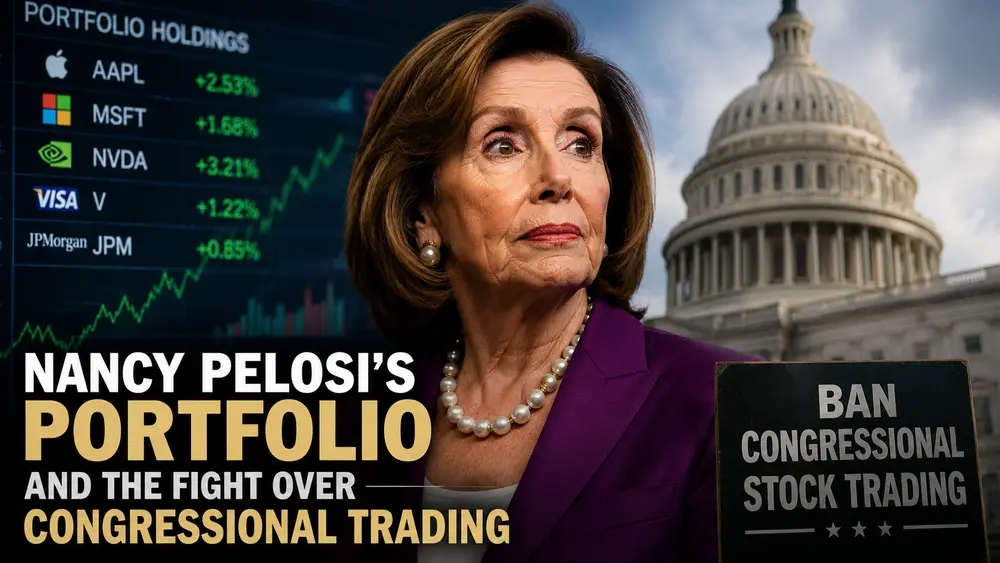
Nancy Pelosi’s Portfolio and the Fight Over Congressional Trading
How does a member of Congress rack up stock returns that embarrass Wall Street's best hedge funds? That's the question behind the Nancy Pelosi portfolio saga — and behind a fight over trading rules that's still going on right now.
Quick note before the numbers: Pelosi announced in November 2025 that she's retiring from Congress, with her final term ending in January 2027.
The debate her portfolio helped ignite is outliving her career.
1. Start With the Numbers
Trackers that follow lawmakers' financial disclosures reported the Pelosi portfolio returned 65.5% in 2023, while the S&P 500 — the main U.S. stock index — gained about 24%.
In 2024 it did even better: up 70.9% against the market's roughly 25%.
Back-to-back years of nearly triple the market has ranked her among the top-performing members of Congress.
For scale: most professional fund managers fail to beat that index at all. Yep, most of them!
How to Check It:
- Unusual Whales — a free tracker showing every disclosed Pelosi trade.
- Quiver Quantitative — tracks trading disclosures for all of Congress.
2. See How the Trades Work
The trades are made by her husband, Paul Pelosi, a longtime professional investor.
His signature move is buying call options on big tech companies — contracts that give the right to buy a stock at a set price, which act like a supercharged bet that multiplies gains when the stock climbs.
Recent favorites have included Nvidia and the cybersecurity firm Palo Alto Networks, and one widely shared analysis pegged the 2024 gains on those positions at 273% and 93%.
How to Check It:
- Congressional trades become public because a 2012 law, the STOCK Act, forces lawmakers to disclose them within 45 days — that's the paper trail every tracker is built on.

- A data-driven look at how everyday millionaires actually live and spend
- Shows why a high income and real wealth are very different things
- Profiles the frugal habits that quietly compound into fortunes
3. Understand the Controversy
Critics ask an uncomfortable question: can people who write the laws — and hear non-public briefings — ever trade stocks on a level playing field with the rest of us?
Even when every trade is legal, the appearance alone corrodes public trust.
Pelosi's response has been consistent: she personally owns no stocks, doesn't direct the trades, and all investing decisions are her husband's alone.
Here's the part that fuels the whole debate: today's rules don't actually stop any of these trades.
The STOCK Act only requires lawmakers to report a trade afterward — and the report can legally arrive up to 45 days after the trade was made.
That's like a referee who reviews the play weeks after the game ended — the points already counted.
How to Think About It:
- When you weigh this debate, ask what a lawmaker could gain from a trade — not just whether the disclosure form got filed on time.
- A rule that only reports a problem after the fact can reveal a conflict of interest, but it can't prevent one.
4. Track the Ban Fight
The pushback turned into legislation with her name on it: the PELOSI Act, later renamed the HONEST Act, would force lawmakers and their spouses to sell individual stocks entirely — it cleared a Senate committee in July 2025, then stalled.
Then came a milestone: in July 2026, the House passed a bill 232–198 barring members of Congress, their spouses, and dependent children from buying individual stocks — existing holdings can be kept or sold with advance public notice.
Its fate in the Senate remains uncertain, and nothing has been signed into law yet.
Pelosi herself, long skeptical of a ban, has publicly backed the recent push.
How to Follow It:
- Congress.gov — search "congressional stock trading" to read each bill's current status for yourself.
5. Watch the Copycats
The fascination created an entire mini-industry of copy-trading.
There's even an exchange-traded fund — ticker NANC — that buys whatever Democratic lawmakers disclose; by late 2024, the Financial Times reported it had returned 37.5% since launch versus the S&P 500's 29.9%.
One catch to remember: copycats buy up to 45 days late, and they're copying a strategy built on options most people shouldn't touch.
If the whole spectacle tempts you, compare it honestly with the boring route — time-tested market lessons and low-cost index funds have made plenty of quiet millionaires.
How to Check It:
- Look up any copy-trading fund's fees and holdings before buying — imitation isn't free, and it isn't instant.

- Turns Jack Bogle's index-fund philosophy into a step-by-step plan
- Covers asset allocation, retirement accounts, and rebalancing without jargon
- Written by the community that has practiced low-cost investing for decades
Wrapping Up
The Pelosi portfolio story is a two-for-one: a jaw-dropping scoreboard, and a mirror held up to how Washington polices itself.
Whether the Senate finishes the ban or lets it stall, the disclosure trail — and the watchdogs reading it — aren't going anywhere.
These are ideas to chew on, not personal instructions or individualized financial advice — your money, your call.
Follow the Smart Money Without Copying It Blindly

The Simple Investing Playbook Wall Street Hates